Ad (728x90)

Showing posts with label Startups. Show all posts

Sunday, 28 February 2016

Union Budget 2016: Expectations from Indian Startups


Unveiling of Union Budget is one such event that is keenly followed by Business Owners, be it small or large. The announcements made during budget shape the financial decisions of many!

With the launch of the ‘Start-Up India Campaign’ and a lot of focus on encouraging start-ups, curiosity has been built around what the budget will offer. How well the government will adopt and accommodate start-up friendly policies and initiatives.

Here are a few quotes from Founders of Startups on their Budget Expectations.

Mr. Sujayath Ali, CEO & Founder, Voonik.com

1. Reward Diversity in Startup workforce: Many startups are preferred places for women, as they get flexible timing, work from home and other benefits. Startups give women a great opportunity to fulfill their personal commitments without compromising success at professional front. I feel, government should encourage diversity, by giving certain tax benefits to encourage inclusion of women in startup workforce.

2. FDI in B2C Ecommerce: Currently there is a lot of confusion in terms of what constitutes B2C ecommerce vs. marketplace and where FDI is allowed. We expect clarity on FDI policy and definition of what entails a marketplace.

3. Removal of Angel / Startup Tax: We are awaiting clarity on the angel tax. While Finance Minister mentioned that provisions will made in the Income Tax Act for exemption to a notified class of investors, we are still awaiting details.

4. Staggered/Laddered Service tax: Even though a 3 year Income tax holiday is given to new startups, the issue of Service tax is not addressed yet. I hope in the new budget, some laddering like that of Income tax slabs is given to startups. This will help us in being able to invest a part of our revenues to business, reduce our dependence on VC funds and once we reach a certain stature we can definitely pay ST at par with other Listed companies.

5. Infrastructure: To make Ecommerce sector profitable, we need a robust delivery system. All ecommerce companies are struggling with delivery delays, package losses in transit etc. For customers, getting their order in time is the bare minimum expectation. On the other hand, for a company to deliver on time through polite courier boys, is a big challenge. Often many courier partners are not equipped to handle cash collected in delivery. In the new Budget, there has to be a more focused plan on improving road & rail infrastructure, so that companies like Voonik can profitably deliver the orders to our customers.

6. Financial innovation for easy credits to SME & small traders: One of the key challenge for our sellers face is the liquidity crunch when they have to suddenly scale up to cater to a huge online demand. I feel, the new budget should encourage NBFCs to create fast, easy and reasonable loans for the sellers who start selling through online retail.

7. Mobile Money: If in the new budget, government can announce rebates/ subsidies through Mobile money platforms, this will help us in encouraging prepaid order placing, thus reducing our cash on delivery handling costs.

Ashish Bhatia – Founder & CEO, Labsadvisor.com

Service tax threshold should be raised significantly: In the Start-up India initiative by the Modi government, start-ups are getting corporate tax exemption for the first three years. However, for most start-ups SERVICE TAX is a bigger concern as it is charged on the revenue or turnover rather than the profit. Companies also have to bear the burden of paying service tax on services that they buy from outside e.g. advertising, web development etc. Service tax raises the cost of doing business significantly. Doing away with the service tax during the first 2-3 years will help vastly and let many more start-ups survive.

TDS deduction should not apply: TDS on employee salaries and contractor payments puts a significant regulatory burden on start-ups. Instead of focusing on operations, the company management has to focus on collecting tax saving documents, deducting and depositing tax, and finally filing the returns. This is not only time consuming but also leads to unnecessary payments to outside agencies like CAs.

Redundancy pay should be tax exempt – Start-ups make mistakes in hiring or have to let go of people due to investment delays. When a company lets go of its employee, generally some redundancy payment is made. This payment should be tax exempt in the hands of the employees. This practice is being followed in UK. Redundancy pay of up to 3 months is tax exempt. This incentive will be very helpful for redundant employees when they are on the lookout for another job.
Mr Kiran Murthi, CEO, AskmeBazaar.com

The roll out of excellent initiatives like Start up India and Digital India by the Indian government is a

step in the right direction as it strives to create a promising environment for budding entrepreneurs. We are hopeful that such campaigns will convert to strong economic growth and increase in overall consumption. We hope that the government will continue giving thrust to various reforms in this sector in the forthcoming Union Budget 2016-17.

As a leading e-commerce brand, with a proud association with millions of SMEs across India, we hope the government will present a futuristic tax policy that will address the complications of the current tax structure. We hope that the GST roadmap will be shared in the budget for FY 2016-17.

Finally we look forward to an ecosystem devoid of red-tapism, paving the way for greater ease in doing business and creating the ground for ‘Innovation’ & ‘Entrepreneurship’.
Sashank Rishyasringa and Gaurav Hinduja, Co-Founder, Capital Float

The Prime Minister’s action plan on startups was the first step to aid the growth of the entrepreneurial ecosystem in India. We hope that the budget will lay the groundwork to create more opportunities for innovation in the startup sector especially in the Fintech space. We expect this Budget to bring parity between the NBFCs and other financial institutions and kick-start the SARFAESI measures, which has been the long standing demand of the NBFCs thereby bringing the regulatory framework in parity with banks.


We believe that this budget would also look at providing monetary incentives under Skill India to small-scale entrepreneurs to help them impart specific training to unskilled labour and a flush of capital into the Technology Acquisition and Development Fund (TADF), meant to help business to acquire the requisite machinery and technology to expand their operations. Incremental steps promised in the Startup India initiative by the Prime Minister will need to become a reality which can in turn set the stage for something big, bold and a game-changer.
Rajiv Kumar, Founder & CEO of StoreHippo.com

We expect the government to simplify tax regime for startups to foster innovation and create conducive ecosystem for entrepreneurs in the country. As a startup, we welcome the move by PM Modi to offer 3 years of tax exemption under the Start-Up India action plan; but more than exemption on Income tax, the statutory and regulatory compliances related to various filings like Service Tax returns, MCA filings, TDS returns and various state specific compliances should be simplified as the filing of these documents consumes a lot of time and bogs down a startup.

We expect the Govt. to introduce e-commerce and startup friendly initiatives that will boost the e-commerce industry. Exemption of the angel tax (that taxes the capital receipts) will help the startup industry, especially when financing from banks and VCs is unavailable. Even the tax rates for the investors should be rationalized, as they also take a risk by investing in startups. Favorable policy regulations like ease of compliance and tax exemptions will boost the sector and contribute to favourable growth of the economy. 

A Dedicated Corpus of Funds announced by the government under Startup India action plan will definitely help entrepreneurs and startups, as many players struggle with funds in the initial stages. However, the Govt. must make sure that the funds are judiciously allocated so that there is uniform distribution across different industry sectors. Also, there should be limit on funds allocated to one startup.

The ‘Startup India, Standup India’ campaign has created excitement and raised hopes for the startups and entrepreneurs. We hope that the budget will lay down a clear roadmap on the execution of all the policies announced.
Varun Dua, CEO & co-founder – Coverfox.com

“The key expectations from Budget 2016 is deregulation and allowing FDI in fin-tech. Most fin-tech businesses like payment banks / insurance have heavy dependence on domestic capital which is mostly risk averse and thus scarce.

The Budget should also  consider relaxation in structures which make private secondary transactions more liquid from a tax or complication perspective.” –

Pankaj Vermani, CEO, Clovia.com

“The E-commerce industry has seen a boom in 2015. To ensure that the growth continues the Union budget needs to provide greater tax clarity especially related to jurisdiction / taxability issues. We are also hoping for a positive clarification for the Central Sales tax on transactions such as cash on delivery, which involve inter-state movement of goods.In addition, today every region has different laws for eCommerce. To govern the sector better one needs better definition of the category and a centralized law.”

Rajiv Sharma,CEO and Co-Founder, dPronto

Start-ups face a lot of teething troubles; keeping this in mind we would like to see the removal of direct and indirect taxes on start-ups. Would even recommend a tax holiday for start-ups (just like that for IT companies during the 90s) for a period of 3 years. Removal of “angel tax” is equally important since Angel funding is crucial to foster the start-up eco-system in India at a time when banks and venture capital funds are pulling away from providing financial aid to such companies. Start-up companies require innovation to grow fast and hence compliance of stringent norms robs off the ingenuity of new beginners. We would like to replace audits with self-reliance certificates as proposed by Nasscom.


One of the pressing issue that most startup entrepreneurs are talking about is clarity in taxation on new businesses and startups. Government needs to definitely bring in more clarity in this budget!

Startups

Foodpanda launches 30 Min Express Delivery in Gurgaon


Foodpanda, popular online food delivery service, has launched a pilot for quick meal delivery in Gurgaon. Promising delivery time of under 30 minutes, the food options range from North Indian to Chinese combo meals from select restaurants; Happy Hakka, Tughlaq, and Biryani Art.

It does not come as a surprise that the offer is not like Dominos where one can get the meal in 30 minutes or less, since that is fast food. Keeping in mind that the preparation of a full fledged meal itself can actually take a lot of time, this is a bold step from Foodpanda to implement it.

Talking about the pilot initiative, Saurabh Kochhar, CEO of Foodpanda India, stated, “The thought behind this originated with the desire to make available pre-set portions of favourite combos within 30 minutes of ordering. We are also cognizant of the fact that most of our corporate users prefer ordering meal combos instead of separate meals. We are doing a pilot run in Gurgaon with 3 restaurants and are confident these curated meals will be enjoyed by our customers.”

Foodpanda will be accepting orders eligible for express delivery from 12:00pm to 4:00pm, which is the lunch time. The meals will not be very expensive, in fact they will cost between Rs 149 to Rs 225 and will be delivered in tower boxes made of plastic, exactly like how we used to have tower tiffin boxes as shown on Indian television.

Well, it makes sense to start the pilot for corporate professionals in Gurgaon, living far away from home to get access to delicious dishes as a combo and not separate food items.

Recent Foodpanda Developments

Foodpanda had recently partnered with IRCTC to deliver food items to train passengers at prominent stations. The food items will have to be booked 2 hours in advance, but you’ll receive completely hot and fresh food delivered to you.

However, Foodpanda has had their share of problems – In December 2015, they fired over 500 employees and stopped delivery in six cities in India.

Foodpanda has invested a lot in India – including acquiring 2 major food delivery startups – TastyKhana and Justeat, but they have found it tough in an already congested food delivery market.

Rumours have been afloat that parent company Rocket Internet has been trying to sell Foodpanda business in India, and even at a very low price tag of $10 to $15 million, they have not been able to find a buyer.

Now, with this development in Gurgaon, it seems they are planning to invest further in this business to make it a success.

We will keep you posted with further developments.
Startups

5 Questions You Must Ask Yourself Before Starting Your Own Venture


Starting one’s own venture is a big step. It requires meticulous planning, dedication, time, and funds. In simple words, there’s a lot at stake. Although the risk or failure cannot be completely avoided it can be minimized by extensive research of the new venture idea and by asking yourself some very critical questions.

The answers to these questions will help you decide whether you want to go ahead with the venture or give it some more thought or not pursue it at all. Honest answers at this stage – the idea generation phase, will not only save you lots of time, energy, and funds, but will also help you arrive at an idea that is both feasible to implement and has a market demand.

So before you set out on working on the business idea, take some time to ask and reflect on the following questions.

1. What problem does this idea address?

This is the most critical question. Every business, to be successful, needs to resolve or fulfill a market demand. Before you invest your time and efforts in an idea – ask yourself this question – try to find out how your target customers will benefit from the business – will it save their time, will it help them save money or will it provide a necessary service. Find out how will your business make life easier for your customers. This will also help you in the later stages when you go out to market and sell your product or service.

2. Is it legal?

Check if your business idea is in compliance with the laws and regulations of the country or state that wish to operate in. Study the laws of the country/state that you are planning to launch your venture. Find out the compliance requirements and accepted business and industry practices.

At this point of time you should also decide what kind of legal entity you want to create for your venture – a sole proprietorship, partnership firm, One Person Company, limited liability partnership, private limited company, public limited company. Each type of business structure has its own benefits and restrictions both legally and for acquiring funding from potential investors.

3. What will you name it?

Shakespeare may not have thought much about names, but entrepreneurs need to. Like legal aspects, meanings of words and names differ from culture to culture, country to country. So it is important to arrive at a name that conveys a positive meaning, specially in the country you intend to operate in.

Apart from the meaning of the name, you must also decide whether you want the name to convey the nature of the business you do, the product you sell or a use a generic name which does not specifically relate to the business activities of the firm.

4. Do you have the time?

A new venture is like a baby. It requires your complete attention and full time to prosper. Before you launch the venture, find out if you can work on it 24*7 for a couple of years or at least till it becomes profitable.

5. How will you fund it?

Once you have answered all the above questions, work out how you will fund it. Study your finances and find out if you can bootstrap and for how long. Learn about funding requirements, figure out whom you can pitch your idea to acquire funding.

After this exercise, if you choose to go ahead – the answers to all the above questions will help you set up the basic frame work of your business idea and also help in creating in a well thought out business plan and strategy!

About the author: The article is written by Divya Chauhan, who is co-Founder at  it’spleaZure.
Startups

Indian Startup Now Officially Defined By The Govt; 5 Year Old Company Is Not A Startup Anymore


During last month’s ‘Startup India Stand Up India’ program, one this which was doubted and questioned the most was the definition of a startup – Is it on digital companies making apps or traditional companies having brick-and-mortar outlets can also be described as a startup?

Is Flipkart a startup having founded in 2007 having $15 billion valuation? Can Paytm be described as a startup having 10 million customers and clocking revenues of Rs 300 crore during Diwali sales last year?

We had actually asked this question: What exactly is a startup, just days before the ‘Startup India Stand Up India’ event.

Thanks to a recent notification issued by Department of Industrial Policy and Promotion, this dilemma is now over.

What Is a Startup?

As per the notification dated February 17, 2016, Ministry of Commerce and Industry has described an entity as a startup if:

a) Its age is less than 5 years from the date of registration/incorporation

b) Turnover for any year is less than Rs 5 crore

c) Its working towards “innovation, development, deployment or commercialization of new products, processes or services driven by technology or intellectual property”

These are the three major pillars which shall define any startup in India; and as per these definitions, neither Flipkart nor Paytm is a startup anymore!

Point to be noted here: Any business/corporation which is created by spliting from an existent business shall not be termed as a startup.

What Exactly Is Registration/Incorporation of A Startup?

An entity shall be described as a startup, if it is registered under Companies Act, 2013 or a registered partnership firm, registered under section 59 of the Partnership Act, 1932 or a limited liability partnership under the Limited Liability Partnership Act, 2002.

Except these three types of registration, no entity shall be deemed as a startup.

Besides, the turnover of Rs 5 crore as defined in this notification would be calculated as per Companies Act 2013 (and subsequent rules/regulations)

What Can A Startup Do?

The third point of the notification detailing the definition of a startup says that the entity shall work towards “innovation, development, deployment or commercialization of new products, processes or services driven by technology or intellectual property”

Basically, this means that the startup can:

a) Develop and commercialize a new product or service or process by using technology or Intellectual Property

b) A ‘significant’ improvement over existing products/services/process/workflow which will add value to the customer’s experience

Now, note here that there merely developing a product or service won’t suffice anymore. In case a product is developed by a startup but it has no potential for commercialization, then that entity won’t be described as a startup.

Similarly, undifferentiated products/services and those businesses which do not add value to customers/workflow won’t be categorized under startups. (ambiguity persists in this clause: Commercialization of WhatsApp is still not clear!)

The notification also details the procedure of creating a startup, wherein DIPP has said that a special mobile app would be developed using which any citizen can register and incorporate a startup with minimum papers and documents.

You can access the notification issued by Department of Industrial Policy and Promotion under Ministry of Commerce and Industry here.

Related stories:

Union Budget 2016: Expectations from Indian Startups

More Reforms Introduced in Companies Act 2013

Startup India Action Plan

Draconian Tax On Seed Funding Removed
Startups

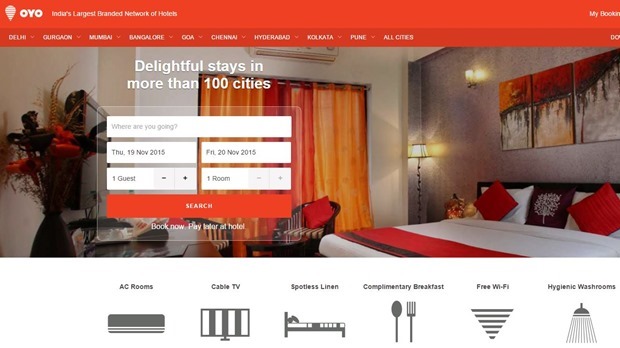
Oyo Rooms Set to Launch Oyo Café & Oyo Care Housekeeping Service

has become a norm with startups in India, isn’t it? Get Funded, Grow aggressively and once you have gained some traction and created your own network in the market, spread horizontally. Ola is doing it, Zomato is doing it and every other well funded startup is doing it in one way or the other.

Oyo Rooms, now a leading a player in branded budget accommodation segment is also walking the same path and spreading its wings. They are set to launch new Food Tech venture as well as Housekeeping service as per an ET report.

Oyo’s food tech venture called Oyo Café will aggregate kitchens from it’s own listed hotels and will sell food under its own brand name.

Oyo has been expanding aggressively since it landed $100 million funding in July of this year. They currently have over 30,000 rooms in 3000 properties across 130 Indian cities under their umbrella.

Interestingly, Oyo Café wants to be just a food supplier and want to partner with other food tech platforms like Zomato or Swiggy to distribute the food for them.

So, every hotel in their network that has a kitchen will be a supplier of food, which third party food delivery platforms can list on their platform and sell it to their consumers.

Maninder Gulati, head of strategy and corporate development at OYO told ET, “As in any food business, we noticed that our partner hotels’ kitchen have excess inventory. So, the idea is, if we can utilize that and use food tech platforms like Zomato or Swiggy to distribute that food then that’s a revenue generation potential for our partner.”

In our view, while this may look as logical extension, it still moves away their core focus of providing Budget rooms to customers.

Along with Oyo Café, the company is also planning to launch on-demand housekeeping and cleaning service called Oyo Care. In this case, the Oyo’s existing area managers in various cities can double-up and start offering housekeeping services to rooms on demand with help of their team. No further details are forthcoming on this as of now.

Oyo Rooms, although a leading player in Budget rooms aggregation space is currently burning cash as they guarantee minimum revenue to hotels for inventory allocated to them. On the other hand they are also incentivizing their customers, which adds heavily to their cash burn. Launch of these additional services are the expected to make up of some of cash burn happening in their core business.

Oyo is entering into segments which are already choc-o-block with competitors. Food-tech & Housekeeping startups have mushroomed in nearly every city in India, many of which have also got good funding. Oyo is a late entrant in this space, and only time will tell if they can garner good market share in this space!

 4 1 Rate This

Startups


We are featured contributor on entrepreneurship for many trusted business sites:

  • Copyright © Free Live TV Channels™ is a registered trademark.
    Designed by Templateism. Hosted on Blogger Platform.